My Obsessions
I have always been like this.
I find something that interests me, and before long interest turns into fascination, fascination into obsession, and suddenly I need to know everything about it. Or, perhaps more accurately, I need to know enough about it.
There is almost always something.
At the moment, it is men's clothing. Not simply clothes themselves, but the history of them, the rules, the whys and why nots, how they were made, how they were worn and how all of this has changed. I am particularly fascinated by what I suppose you could call the golden age of menswear, roughly the 1930s through the 1950s.
There is reading, too. Whether I like it or not, 2026 has apparently become the year of science fiction. I've read other, arguably more interesting books, but science fiction has thoroughly dominated my reading list this year.
And then there is Marmite.
I have decided that I want to love Marmite.
I don't, yet. But this appears to be merely a technicality. I eat it, experiment with it, adjust quantities and combinations and generally continue exposing myself to the stuff in the expectation that, eventually, I will understand what the British have been going on about.
I have done this before.
One morning, years ago, I decided that I wanted to love whisky. There wasn't much more to it than that. I promptly started researching whisky. How it is made, where it is made, how the different regions differ, what peat does, what the various distilleries are known for, how to drink it and, naturally, which bottles I ought to try.
Somewhere along the way, I actually started liking it.
I am by no means an expert, but I now have a slightly unreasonable amount of whisky knowledge stowed away in my head. Drinking whisky remains one of my favourite, oddly personal pastimes, and I tend towards the smokier Scotch whiskies, Lagavulin 16 in particular.
This is more or less how it goes.
I read or watch just enough for inspiration to strike, and then I want to get my hands in, on and around the thing. For a while it pushes almost everything else aside. I read, make, collect, experiment and, inevitably, research what equipment I need.
I do buy the gear.
But I don't particularly enjoy buying lots of things. I enjoy finding the right thing. I'd rather spend an unreasonable amount of time researching a tool, buy one very good example of it, and keep it for the rest of my life.
Doing things properly matters to me. Tradition matters. Understanding why something is done a particular way matters.
And so I dive in.
The Graveyard
There have been quite a few of these obsessions over the years:
- Woodworking
- Leatherworking
- Bushcraft
- Bonsai trees
- Fish tanks
- Nick Offerman
- Croissants
- Dice
- Cardistry
- Magic: The Gathering
- Painting miniature figures
- Board games
Calling this The Graveyard is perhaps unfair, because very few of these things are actually dead.
More than ten years ago, I became fascinated with woodworking. I studied it, bought tools and carved wooden spoons. Big ones, small ones, different woods and different shapes. Eventually the obsession subsided.
We still use the spoons in our kitchen today.
Leatherworking went much the same way. I learned the basics, bought the tools and made pouches, desk mats and various little leather accessories. Then, eventually, I had scratched the itch.
There was cardistry. I researched the cards, bought the cards and spent a couple of months practising elaborate ways of moving those cards around my hands. I haven't seriously practised it in years.
Bonsai has never entirely gone away. I've read about it, watched endless videos and already know precisely which tools I want. I have, somewhat inconveniently, never actually planted my first tree.
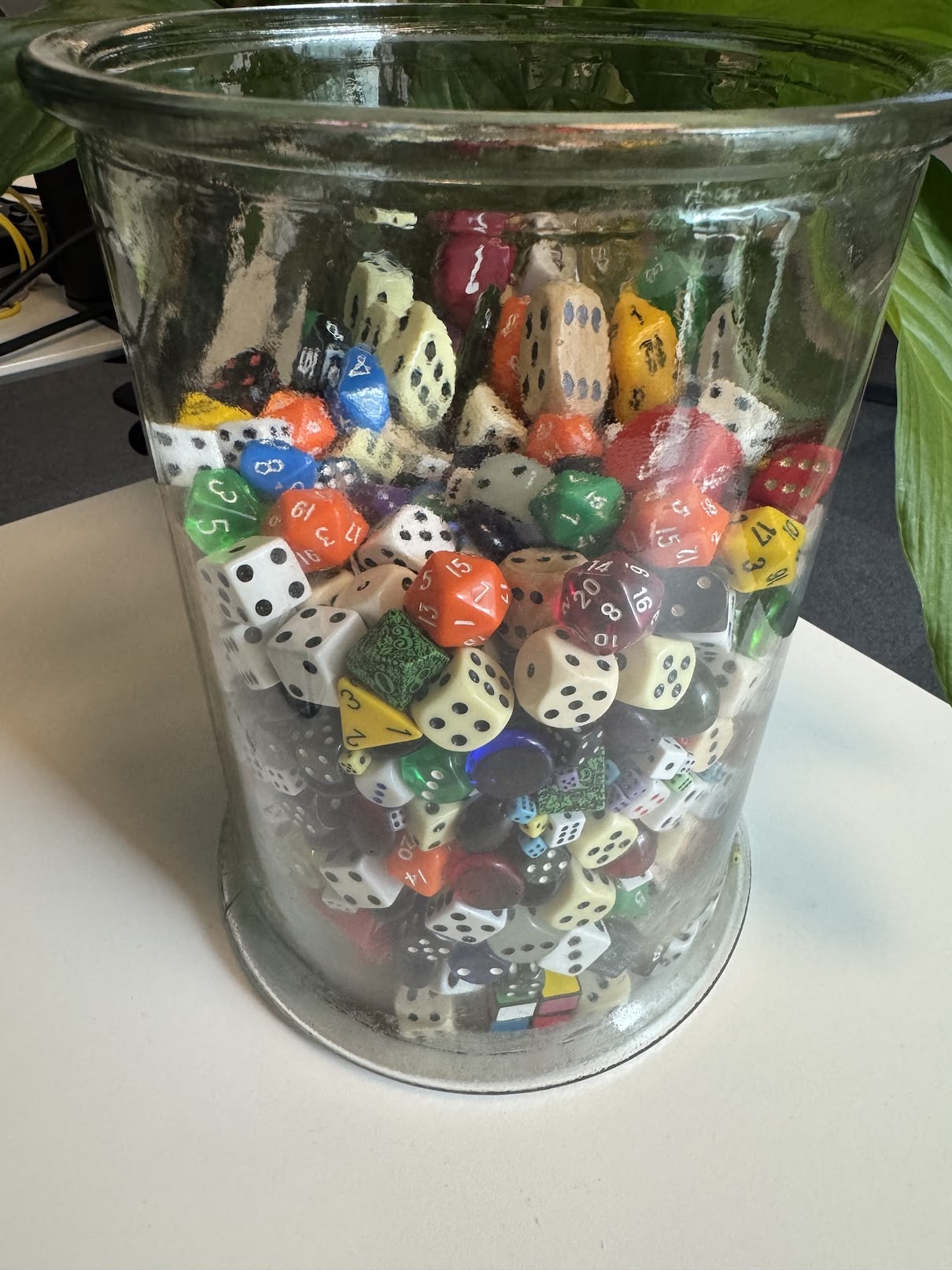
And then there are the dice.
I have 4.3 kilograms of dice.
I don't know how many dice that is. They live in a large jar, and whenever I stumble upon an interesting one, it goes in. These days I probably buy a couple of dice a year. I don't know why.
I don't think any of these interests were wasted.
I don't really lose interest in things. There are simply subjects I reach a point of being satisfied with. I've explored them enough. I've scratched the itch. I move on, but some small part of the thing comes with me.
It becomes part of the ever-evolving collection of things that make me, me.
Knowing enough to know nothing
I have no great desire to become an expert in everything I become fascinated by.
In fact, there is usually a rather distinct point in an obsession where I know enough to realise just how little I know.
I rather like that point.
My wife sometimes describes my knowledge of these strange subjects as expert knowledge. It isn't. It just happens that if you spend a few months reading about whisky, tailoring, fountain pens or Rubik's cubes, you quickly know more about the subject than any reasonable person has cause to know.
But the wonderful thing is that almost everything gets bigger the closer you look at it.
This may be the closest thing I have to a universal truth.
Paper isn't just paper.
A suit isn't just a jacket and a pair of trousers.
Whisky isn't simply distilled alcohol.
Wine isn't fermented grapes.
An umbrella isn't merely something that keeps the rain off your head.
Pull at almost any loose thread in the world and an entire universe comes tumbling out. There is history and craft and science and tradition and terminology and, without fail, a small community of people who have devoted a significant portion of their lives to knowing everything there is to know about it.
Knowing more rarely makes something less interesting to me.
Usually, it reveals how much more there is to know.
Some things stick
Some obsessions eventually become something else entirely.
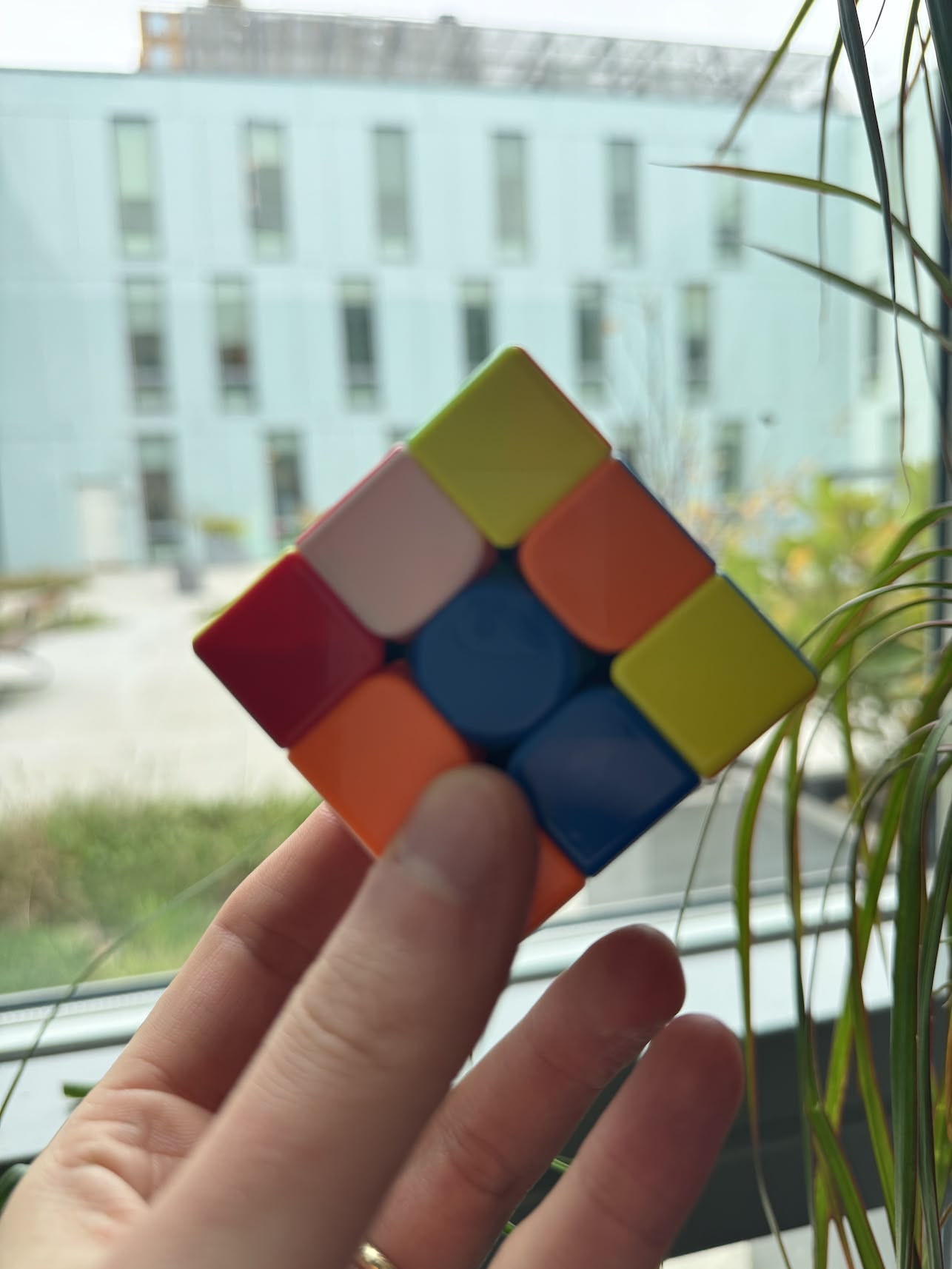
At some point, I decided I wanted to learn how to solve a Rubik's cube.
There is absolutely no practical reason to know how to solve a Rubik's cube quickly. It is a useless skill. A party trick at best.
Naturally, I spent hours every day practising it.
I learned algorithms. Then more algorithms. I learned finger tricks. I learned how to recognise cases without rotating the cube. I practised until solving it became almost entirely automatic.
My personal record is 12.4 seconds, although an indecent amount of luck was involved in that particular solve.
Eventually, I stopped caring about getting faster.
But the cube stayed.
There is a Rubik's cube on every desk I regularly use, both at home and at work. There is almost always one in my bag. I solve them occasionally, but more often I simply scramble one while I'm thinking. Something that started as a completely pointless obsession has become a surprisingly soothing way of occupying my hands while my brain is somewhere else.
Wine has stayed too.
My wife and I attended wine school last year, and since then we've been exploring wine together. It has been tremendous fun precisely because it is something we share. Italian wine remains my favourite, Barolo in particular, but the real pleasure has been discovering how enormous the world of wine becomes once you begin paying attention to it.
So has mixology.
I still regularly play around with it, coming up with cocktails of my own or variations of existing ones. My favourite concoction to date is a coconut and banana flavoured cocktail I call the Bad Break Banana Banshee.
And then there is coding.
Coding started as an obsession. I wanted to make things and discovered that code was a tool with which I could make almost anything I could imagine.
That one got slightly out of hand.
I now run two software companies.
Is there a difference?
I've sometimes wondered whether I have a problem distinguishing between being interested in something and needing to do something with it.
But I'm not entirely convinced there is a difference.
If I become interested in cooking, at some point I will probably build a recipe app.
If I become interested in some small problem, I will probably try to make a tool that solves it.
Just yesterday evening, inspiration struck and I suddenly wanted to build an entirely new version of Senbee Connect. I started sketching and outlining. Then I started building. I ate dinner in front of the computer because stopping seemed deeply inconvenient.
By the end of the evening, I'd dropped the idea.
Nothing came of it.
I don't regret the evening in the slightest.
I made something. I explored an idea. I found out where it went. It occupied me completely for a few hours, and then I was satisfied.
Not everything needs to become something.
Perhaps that is why I don't feel guilty about the hobbies I've abandoned or the projects I've never finished. Finishing wasn't necessarily the point.
The doing was.
Freedom
There is a cost to living like this, although perhaps not the obvious one.
I need freedom.
My interests and obsessions mean that I've built a life that looks somewhat different from the one I might otherwise have had.
I've said no to money to preserve my independence, and I continue to do so. I live relatively small. I don't drive, though I can. I don't particularly desire to bind myself to property or accumulate obligations merely because that is what one is expected to do.
I cannot compromise much on this.
I've always been this way. It is probably one of the reasons I am self-employed and have never really held what I would consider a normal job.
I need the freedom to wake up and follow an idea.
I require the freedom to be me, and to be a different me tomorrow.
That doesn't mean a life without commitments. Quite the opposite.
My wife probably knows this side of me better than anyone, and I think, or at least hope, that she rather adores it. She has watched enough obsessions arrive by now to recognise the symptoms.
In a strange way, she is one of them too.
Not a hobby, obviously, and certainly not something to be scratched off a list once satisfactorily explored. But our relationship occupies a similar place in me. It is something I pour myself into. Something I remain endlessly interested in, something I want to understand, nurture, experience and continue discovering.
Some obsessions are temporary.
The best ones get deeper.
The next thing
If money were no object and you asked me today, 1 October 2026, what I wanted to do next, I think I would open a haberdashery.
A proper one.
A small shop dealing in beautiful men's things. Clothes, accessories, umbrellas, walking sticks, fountain pens, perhaps good paper. Things made properly and intended to last.
I have already thought about it far more than the business case warrants.
The business case, incidentally, is probably terrible.
Ask me again in a month and I'll likely give you a completely different answer.
And I rather like that.
There are still languages I want to learn. I want to speak better English, and learn Italian and German. I want to understand the global economy properly. I want to understand business operations at a level I currently don't.
I still haven't planted that bonsai tree.
There are books I haven't read, wines I haven't tasted, operas I haven't seen, things I don't know how to make, places I haven't been and entire fields of human knowledge whose existence I am not even aware of yet.
Someone might reasonably ask why any of this matters.
Why spend hundreds of hours learning to solve a plastic cube?
Why know about the construction of a 1930s suit?
Why learn how Scotch whisky is made?
Why care about paper?
Why make fresh pasta when perfectly good dried pasta exists?
Why own 4.3 kilograms of dice?
Why bother knowing all this stuff?
Why not?
I have one life.
I owe it to myself to wake up at five in the morning excited for a new day and everything it might contain.
There will always be another thing to learn. Another craft to try. Another book to read. Another idea to make. Another subject which, from a distance, looks simple and which, upon closer inspection, opens into an entire world.
I don't find it frustrating that I will never understand all of it.
I find it fascinating that I never can.